
<article> <header> <h1>Haemorrhoids (Piles): Common Questions About Symptoms, Treatment & Surgery</h1>
<p>Piles, medically called haemorrhoids, are common and can cause bleeding, itching, pain, swelling or a lump around the anus. Many cases improve with changes in bowel habits and simple treatment, while some persistent or prolapsing haemorrhoids may need a procedure or surgery.</p>

<p>This guide answers the common questions patients search for about piles symptoms, causes, treatment without surgery, laser treatment, piles surgery, recovery and recurrence. Because rectal bleeding can have causes other than haemorrhoids, getting the diagnosis right is an important first step.</p>
</header>
<nav aria-label="In this guide"> <p><strong>In This Guide</strong></p> <ul> <li><a href="#understanding-haemorrhoids">What Are Piles (Haemorrhoids)?</a></li> <li><a href="#symptoms-diagnosis">Piles Symptoms, Bleeding & Diagnosis</a></li> <li><a href="#treatment-home-care">Piles Treatment Without Surgery & Home Care</a></li> <li><a href="#piles-surgery-procedures">Piles Surgery, Laser & Other Procedures</a></li> <li><a href="#recovery-recurrence">Recovery, Pain & Recurrence</a></li> <li><a href="#when-see-doctor">When Should You See a Doctor?</a></li> <li><a href="#faq">Frequently Asked Questions About Piles</a></li> </ul> </nav>
<section id="understanding-haemorrhoids"> <h2>What Are Piles (Haemorrhoids)?</h2>
<h3>What are piles or haemorrhoids?</h3>
<p>Haemorrhoids are enlarged or displaced vascular cushions in the anal canal and lower rectum. They can be internal, developing inside the anal canal, or external, developing under the skin around the anus. They become symptomatic when they enlarge, bleed, prolapse, become inflamed or develop a blood clot.</p>

<h3>What causes piles?</h3>
<p>There is usually no single cause. Constipation, hard stools, straining during bowel movements, prolonged sitting on the toilet, chronic diarrhoea, pregnancy, increasing age and other factors that increase pressure in the anorectal region can contribute to haemorrhoids.</p>

<h3>Does constipation cause piles?</h3>
<p>Constipation can contribute to piles because hard stools often lead to repeated straining. Keeping stools soft and avoiding excessive straining are important parts of both treatment and prevention.</p>

<h3>Can diarrhoea also cause piles?</h3>
<p>Yes. Repeated diarrhoea and frequent irritation around the anus can contribute to haemorrhoidal symptoms. Persistent diarrhoea should be assessed and treated rather than assuming that the symptoms are simply piles.</p>
</section>
<section id="symptoms-diagnosis"> <h2>Piles Symptoms, Bleeding & Diagnosis</h2>
<h3>What are the symptoms of piles?</h3>
<p>Common piles symptoms include bright-red bleeding during or after passing stool, itching, irritation, swelling, pain, a lump around the anus and a feeling of incomplete bowel emptying. Internal haemorrhoids commonly cause painless bleeding, while external or prolapsed haemorrhoids are more likely to cause discomfort or pain.</p>

<h3>Why do piles bleed?</h3>
<p>Internal haemorrhoids can bleed when stool passes over the enlarged tissue, particularly when there is straining or hard stool. The blood is often bright red and may appear on toilet paper, on the stool or in the toilet bowl.</p>

<h3>Are piles always painful?</h3>
<p>No. Internal haemorrhoids are often painless, even when they bleed. Significant pain is more commonly associated with an external haemorrhoid, thrombosis, prolapse or another anal condition such as an anal fissure.</p>

<h3>Can piles cause a lump near the anus?</h3>
<p>Yes. A lump may be an external haemorrhoid, a prolapsed internal haemorrhoid or a thrombosed haemorrhoid. However, not every lump around the anus is a pile, so a new, persistent or unusual lump should be examined.</p>

<h3>How are piles diagnosed?</h3>
<p>A doctor usually diagnoses haemorrhoids from the symptoms and an examination of the anal region. Depending on the symptoms, examination may include a digital rectal examination and inspection of the anal canal using an anoscope or proctoscope. Further bowel evaluation may be advised when the bleeding pattern or other symptoms warrant it.</p>

<p>Rectal bleeding should not automatically be attributed to piles. Other causes include anal fissure, inflammatory bowel disease, polyps and colorectal cancer, so persistent or unexplained bleeding deserves appropriate medical assessment.</p>
</section>
<section id="treatment-home-care"> <h2>Piles Treatment Without Surgery & Home Care</h2>
<h3>Can piles go away on their own?</h3>
<p>Yes, mild haemorrhoids can improve on their own, particularly when constipation, hard stools and straining are addressed. Symptoms may settle over several days to a week, but recurrent or persistent symptoms should be assessed rather than repeatedly self-treated.</p>

<h3>How can piles be treated without surgery?</h3>
<p>Many patients can initially be managed without surgery. Treatment may include increasing dietary fibre, drinking adequate fluids, using fibre supplements or stool-softening treatment when appropriate, avoiding straining and prolonged toilet sitting, and using short-term medicines for symptoms.</p>

<h3>What should I eat if I have piles?</h3>
<p>A fibre-rich diet helps make stools softer and easier to pass. Fruits, vegetables, whole grains, pulses and other fibre-rich foods can be useful, and fibre should generally be increased gradually along with adequate fluid intake.</p>

<h3>What should I avoid when I have piles?</h3>
<p>The main things to avoid are habits that make bowel movements difficult: straining, spending a long time on the toilet and repeatedly delaying the urge to pass stool. If certain foods worsen constipation or diarrhoea for you, reducing them may also help.</p>

<h3>Do piles creams cure haemorrhoids?</h3>
<p>Piles creams can temporarily reduce symptoms such as itching, irritation, swelling or pain, but they do not necessarily remove the underlying haemorrhoid. Products containing corticosteroids or local anaesthetics may be useful for short-term symptom relief, but prolonged or inappropriate use should be avoided.</p>

<h3>Can I treat piles at home?</h3>
<p>Mild symptoms can often be managed initially at home with fibre, adequate fluids, better toilet habits and simple symptom relief. If symptoms persist, keep recurring, or include significant bleeding or severe pain, medical assessment is advisable.</p>
</section>
<section id="piles-surgery-procedures"> <h2>Piles Surgery, Laser & Other Procedures</h2>
<h3>Do all piles require surgery?</h3>
<p>No. Most patients with haemorrhoids do not need surgery. Treatment depends on the type and grade of haemorrhoid, the amount of bleeding or prolapse, response to conservative treatment and the effect of symptoms on daily life.</p>

<h3>What are the grades of internal piles?</h3>
<p>Internal haemorrhoids are commonly classified into four grades. Grade I remains inside the anal canal, Grade II prolapses during straining but returns on its own, Grade III prolapses and requires manual reduction, and Grade IV remains prolapsed and cannot be pushed back in. External haemorrhoids are not classified using this Grade I-IV system.</p>

<h3>Can Grade 1 piles be treated without surgery?</h3>
<p>Yes. Grade I haemorrhoids are commonly managed with fibre, improved bowel habits and medical treatment when needed. If bleeding continues despite these measures, an office-based procedure such as rubber band ligation may be considered.</p>

<h3>Can Grade 2 piles be treated without surgery?</h3>
<p>Often, yes. Many Grade II haemorrhoids improve with conservative treatment, while persistent bleeding or prolapse may be treated with an office procedure such as rubber band ligation or another appropriate technique.</p>

<h3>Do Grade 3 piles always need surgery?</h3>
<p>No, not automatically. Some Grade III haemorrhoids can be treated with less invasive procedures, but significant or persistent prolapse may make surgery a more appropriate option. The decision depends on the individual anatomy and symptoms.</p>

<h3>Can Grade 4 piles be treated without surgery?</h3>
<p>Grade IV haemorrhoids remain prolapsed and cannot be manually reduced. Because significant prolapse is present, surgery is often considered, but the exact procedure depends on the haemorrhoid pattern, symptoms and the patient's overall condition.</p>

<h3>What is rubber band ligation for piles?</h3>
<p>Rubber band ligation is an office-based treatment mainly used for internal haemorrhoids. A small band is placed around the base of the haemorrhoid, cutting off its blood supply so the tissue shrinks and eventually separates.</p>

<h3>What is haemorrhoidectomy?</h3>
<p>Haemorrhoidectomy is an operation in which symptomatic haemorrhoidal tissue is surgically removed. It remains an important and effective treatment for selected patients, particularly those with large, advanced or recurrent haemorrhoids and significant prolapse.</p>

<h3>Is conventional piles surgery very painful?</h3>
<p>Haemorrhoidectomy generally causes more postoperative pain than less invasive procedures because healing occurs in the operated anal area. Modern pain-control measures, stool-softening treatment and appropriate postoperative care can make recovery more manageable.</p>

<h3>What is stapler surgery for piles?</h3>
<p>Stapled haemorrhoidopexy is mainly used for internal haemorrhoids with prolapse. Instead of removing the external haemorrhoidal tissue, the procedure repositions prolapsing tissue and reduces its blood supply.</p>

<p>Stapled procedures may cause less early postoperative pain and allow faster recovery than conventional haemorrhoidectomy in selected patients, but recurrence can be higher. It is therefore not automatically the better option for every patient.</p>

<h3>Is laser treatment for piles better than conventional surgery?</h3>
<p>Laser haemorrhoid procedures can offer less postoperative pain and faster early recovery in selected patients, particularly compared with conventional excisional haemorrhoidectomy. However, laser is not automatically superior for every type or grade of haemorrhoid, and recurrence and long-term outcomes also need to be considered.</p>

<h3>Is laser treatment a permanent cure for piles?</h3>
<p>No treatment can honestly guarantee that piles will never recur. Laser treatment can be effective for appropriately selected patients, but recurrence remains possible and depends on the type of haemorrhoid, procedure used, bowel habits and other individual factors.</p>

<h3>Is laser piles surgery painless?</h3>
<p>No surgery should be described as completely painless. Laser techniques may cause less postoperative pain than conventional haemorrhoidectomy in selected patients, but some discomfort, bleeding or bowel-related pain can still occur during recovery.</p>

<h3>Can piles be removed in one day?</h3>
<p>Some haemorrhoid procedures are performed as day-care treatments, allowing a patient to return home on the same day. This does not mean that the haemorrhoid has completely healed in one day; recovery varies according to the procedure and the individual patient.</p>
</section>
<section id="recovery-recurrence"> <h2>Piles Surgery Recovery, Pain & Recurrence</h2>
<h3>How long does it take to recover from piles surgery?</h3>
<p>Recovery depends on the procedure. Less invasive procedures generally allow a faster return to normal activities, while recovery after haemorrhoidectomy can take longer because the operated area needs time to heal. Your surgeon should give you an expected recovery period based on the exact procedure performed.</p>

<h3>When can I return to work after piles surgery?</h3>
<p>Some patients return to light activities within a few days after minimally invasive treatment, while conventional haemorrhoidectomy may require a longer recovery period. The timing depends on the procedure, pain, occupation and how the wound is healing.</p>

<h3>Will I have pain while passing stool after piles surgery?</h3>
<p>Some pain or discomfort during bowel movements is common, particularly after haemorrhoidectomy. Keeping stools soft, drinking adequate fluids, taking prescribed medicines and avoiding straining can make this period easier.</p>

<h3>Can piles come back after surgery?</h3>
<p>Yes. Treatment can remove or reduce existing haemorrhoids, but it cannot remove the tendency to develop haemorrhoidal disease. Constipation, straining and other risk factors can contribute to recurrence, so long-term bowel habits remain important.</p>

<h3>How can I prevent piles from coming back?</h3>
<p>Keep stools soft with adequate fibre and fluids, avoid straining, do not spend unnecessary time on the toilet and stay physically active. Treating recurrent constipation or diarrhoea is also important.</p>
</section>
<section id="when-see-doctor"> <h2>When Should You See a Doctor?</h2>
<h3>When should bleeding piles be checked by a doctor?</h3>
<p>Any recurrent rectal bleeding deserves medical attention rather than being automatically labelled as piles. Assessment is particularly important when bleeding is persistent, heavy, associated with changes in bowel habits, abdominal symptoms, weight loss, anaemia or other unusual symptoms.</p>

<h3>When is piles bleeding an emergency?</h3>
<p>Seek urgent medical attention for heavy or continuous rectal bleeding, large blood clots, dizziness, fainting, severe weakness or severe anal pain. Bleeding accompanied by fever, abdominal pain or significant illness also requires prompt assessment.</p>

<h3>Can piles cause cancer?</h3>
<p>No, haemorrhoids do not turn into cancer. However, rectal bleeding caused by another condition can be mistaken for piles, which is why persistent or unexplained bleeding should not simply be self-treated.</p>

<h3>How do I know if it is piles, a fissure or a fistula?</h3>
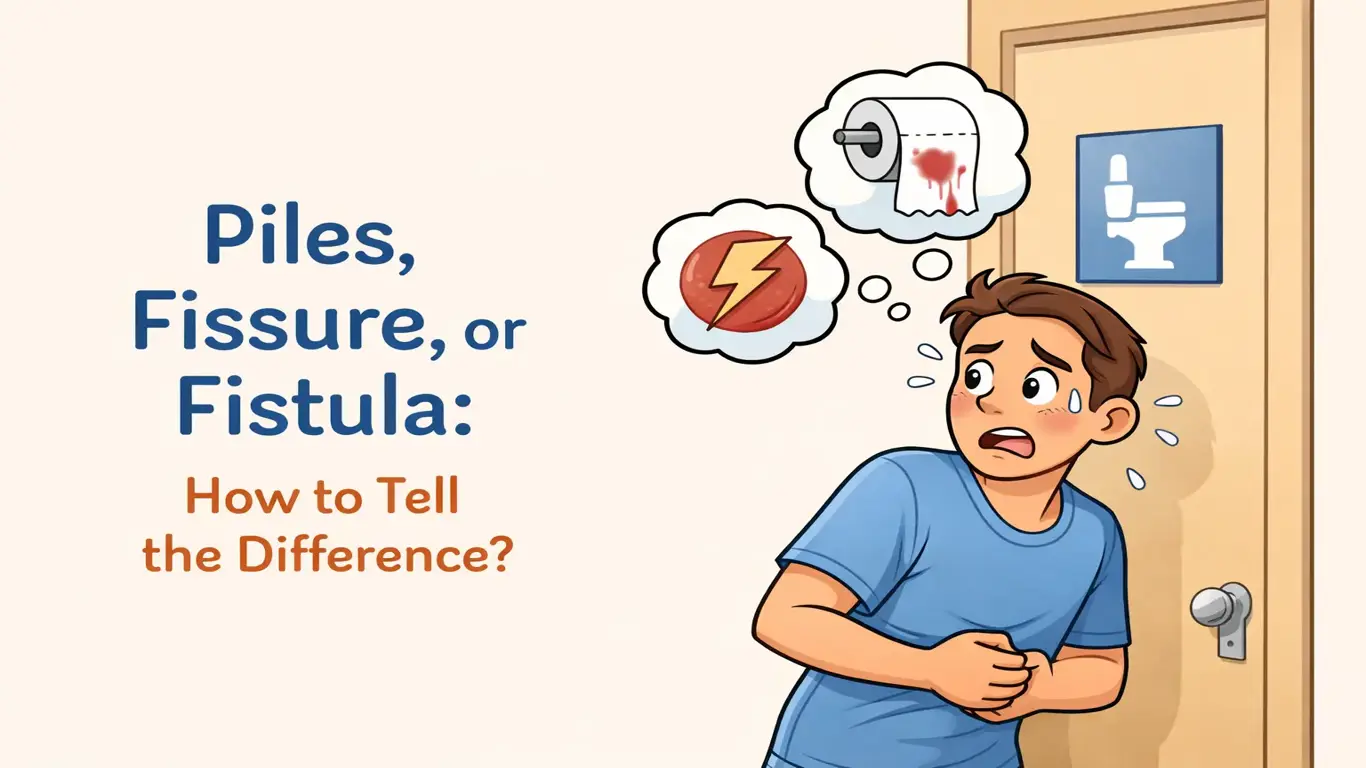
<p>Piles commonly cause bleeding, itching, swelling or prolapse. An anal fissure typically causes sharp pain during or after passing stool, while an anal fistula may cause recurrent discharge, a small opening or swelling near the anus. Because symptoms can overlap, an examination is often needed to distinguish them.</p>
</section>
<section id="faq"> <h2>Frequently Asked Questions About Piles</h2>
<h3>Can piles go away permanently?</h3>
<p>Mild haemorrhoids can settle completely, but the tendency to develop piles can remain. Even after a procedure or surgery, recurrence is possible, particularly if constipation and straining continue.</p>

<h3>Can I exercise if I have piles?</h3>
<p>Yes, regular physical activity can help bowel function and reduce constipation. During an acute painful episode or after surgery, however, the type and intensity of exercise should be adjusted according to medical advice.</p>

<h3>Can piles burst?</h3>
<p>A thrombosed external haemorrhoid can sometimes ulcerate and bleed, which patients may describe as a pile “bursting.” Sudden or significant bleeding should not be assumed to be harmless and should be medically assessed.</p>

<h3>Can piles cause itching?</h3>
<p>Yes. Haemorrhoids can cause itching and irritation around the anus, particularly when there is mucus, prolapse or local irritation. Excessive rubbing or repeated cleaning can make the symptoms worse.</p>

<h3>Can piles cause mucus discharge?</h3>
<p>Prolapsing internal haemorrhoids can sometimes be associated with mucus staining or discharge. Persistent discharge, pus, increasing pain or swelling needs assessment because other conditions such as an anal fistula or infection may cause similar symptoms.</p>

<h3>Is piles surgery covered by health insurance in India?</h3>
<p>It depends on the individual health insurance policy, including its waiting periods, exclusions, pre-existing disease provisions, network-hospital rules and the procedure being performed. The exact policy wording should be checked before treatment.</p>

<h3>How much does piles surgery cost in India?</h3>
<p>There is no single standard cost for piles surgery. The total expense can vary with the procedure, grade and complexity of haemorrhoids, surgeon and hospital charges, anaesthesia, investigations, room category and postoperative care. A proper estimate should be provided after clinical assessment rather than quoting one fixed price for every patient.</p>

<h3>Which piles treatment is best?</h3>
<p>There is no single best procedure for everyone. The appropriate treatment depends on whether the haemorrhoids are internal or external, their grade and degree of prolapse, the main symptoms, previous treatment and the patient's expectations and health.</p>

<h3>Can piles be treated without surgery?</h3>
<p>Yes. Many patients improve with fibre, adequate fluids, better toilet habits and appropriate medicines, while persistent internal haemorrhoids may respond to office procedures such as rubber band ligation. Surgery is reserved for selected patients when symptoms, prolapse or recurrence make it appropriate.</p>
</section>
<section id="bottom-line"> <h2>The Bottom Line</h2>
<p>Piles are common and do not automatically mean that you need surgery. Mild haemorrhoids often improve with fibre, adequate fluids, treatment of constipation and better bowel habits, while persistent bleeding or prolapse may require an office procedure or surgery.</p>

<p>Laser treatment, stapled procedures and conventional haemorrhoidectomy all have a role in appropriately selected patients, but none should be presented as a universal or permanent cure. The right treatment starts with confirming the diagnosis and understanding the type and severity of the haemorrhoids.</p>
</section>
<section id="exacura-help"> <h2>How Exacura Can Help</h2>
<p>At Exacura, the focus is on getting the diagnosis right before recommending a procedure. We help patients understand whether their symptoms are actually due to haemorrhoids, whether treatment without surgery is reasonable, and what the advantages, limitations, recovery and expected costs of different treatment options may be.</p>

<p>The aim is not to recommend a procedure simply because it is available. It is to identify the appropriate treatment for the individual patient, avoid unnecessary interventions and provide clear guidance through consultation and follow-up.</p>

<p><a href="/contact">Book a Surgery Consultation</a></p>
</section> </article>