


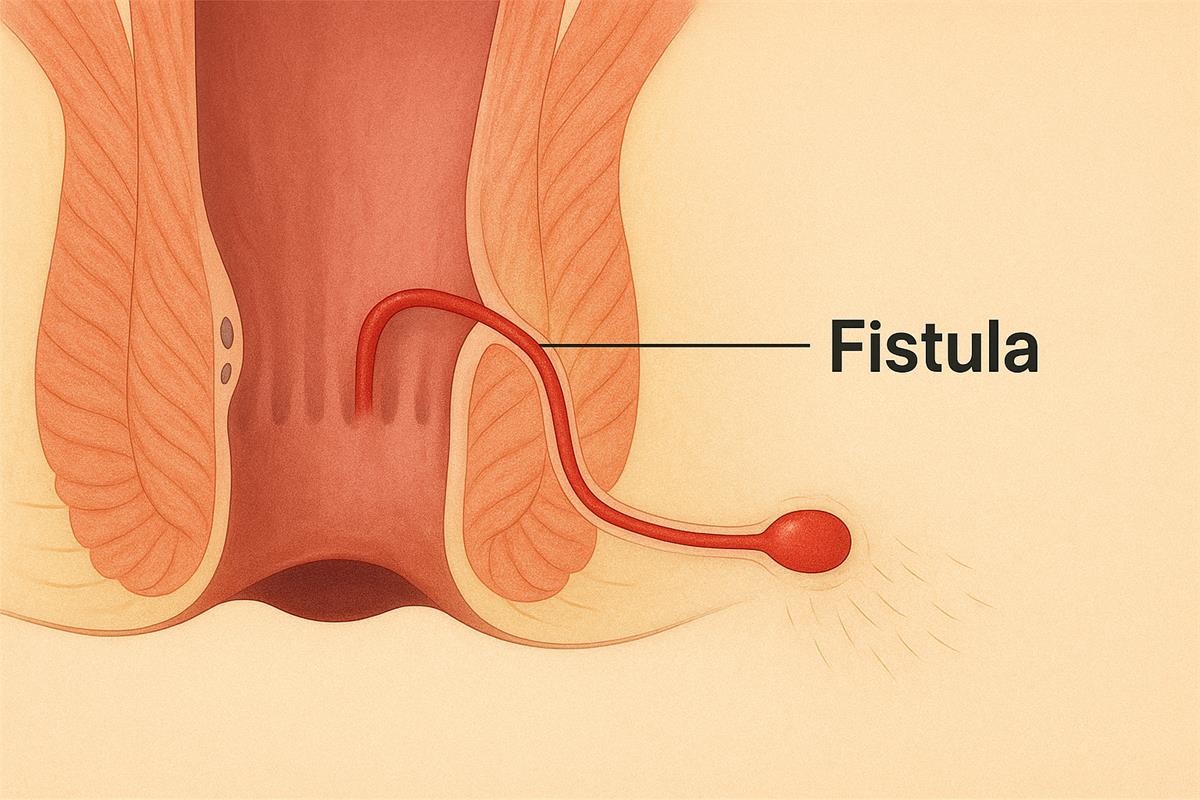
Anal Fistula Surgery (Fistula-in-Ano)
An anal fistula is a small tunnel that forms between the inside of the anus/rectum and the skin around the anus. It usually starts as an infected anal gland (abscess) that drains but leaves behind a permanent tract. Anal fistulas do not heal on their own in most cases and often need surgical treatment.
Common Causes
- Previous anal abscess
- Blocked anal glands
- Long-standing piles or fissure with infection
- Inflammatory bowel disease such as Crohn’s disease
- Trauma or previous anal surgery
- Rarely, tuberculosis or other specific infections
Symptoms
- Persistent or recurring discharge (pus or blood) near the anus
- Pain or burning around the anal area
- Swelling or a small opening or boil that keeps returning
- Staining of underwear due to discharge
- Occasional fever with active infection
- Itching or irritation around the anal region
Is an Anal Fistula Dangerous?
It is usually not life-threatening but can keep causing infection and discomfort. Untreated fistulas can become complex with multiple tracts, interfere with sitting or hygiene, and increase the risk of deeper infection.
When Should You See a Doctor?
If you have a recurrent boil near the anus, persistent discharge, repeated swelling or pain, or a history of anal abscess with ongoing symptoms, a surgical evaluation is recommended.
Diagnosis
Your surgeon will assess symptoms, examine the anal region, and may advise tests such as MRI or ultrasound to map the tract, colonoscopy if inflammatory bowel disease is suspected, and blood tests when infection is significant.
Treatment Options for Anal Fistula
Medication alone usually cannot cure a fistula. Surgery is chosen based on the complexity of the tract, location, and the need to preserve continence.
Fistulotomy
This is the most common procedure for simple, low fistulas.
How it’s done:
The surgeon identifies the entire fistula tract, opens it along its length, removes infected tissue, and allows it to heal as a flat wound from inside outward. The internal opening is also cleaned and left open to drain.
When it’s chosen:
When the tract passes through minimal sphincter muscle.
Considerations:
Healing usually takes a few weeks. Risk to continence is low when selected properly.
Fistulectomy
How it’s done:
The entire tract is excised (cut out) rather than just opened. This gives a clean removal of all infected tissue but creates a larger wound.When it’s chosen:
For simple tracts where complete removal offers long-term benefit.Considerations:
Healing takes longer than fistulotomy but recurrence may be slightly lower.Seton Placement
How it’s done:
A soft thread (seton) is passed through the fistula tract and tied externally.There are two types:
– Draining seton: keeps the tract open to drain infection and prepare for later surgery.
– Cutting seton: slowly tightens over weeks to gradually cut through the tract while allowing controlled healing.
When it’s chosen:
High fistulas where direct division risks damaging the sphincter.Considerations:
May require multiple visits. Helps avoid incontinence in challenging anatomy.LIFT Procedure (Ligation of Intersphincteric Fistula Tract)
A controlled technique designed specifically to preserve sphincter muscle.
How it’s done:
A small incision is made between the internal and external sphincter muscles.The tract is exposed, tied off at both ends, and divided.
The internal opening is securely sealed.
When it’s chosen:
Suitable for trans-sphincteric fistulas where the tract crosses muscle.Considerations:
Minimal muscle damage, low risk of continence issues, moderate healing time.Advancement Flap Surgery
Used for recurrent, high, or complex fistulas.
How it’s done:
The internal opening is cleaned and closed.A flap of healthy rectal or anal mucosa (or skin) is mobilized and stretched over the opening to reinforce closure.
The external tract may be cleaned or removed depending on anatomy.
When it’s chosen:
Cases where protecting sphincter muscles is essential.Considerations:
Technically demanding. Healing requires careful follow-up and good bowel control.
VAAFT (Video-Assisted Anal Fistula Treatment)
A minimally invasive endoscopic technique.
How it’s done:
A tiny scope enters the tract, allowing direct visualization of the internal opening. The surgeon destroys the tract lining using a cautery probe, cleans debris under vision, and closes the internal opening with staplers or sutures.When it’s chosen:
Complex tracts where mapping under direct view is beneficial.Considerations:
Less tissue damage, faster recovery, suitable for selected cases.FiLaC (Fistula Laser Closure)
Laser-based closure of the tract.
How it’s done:
A radial laser fibre is inserted through the tract. As the surgeon withdraws it slowly, laser energy collapses and seals the tract from inside.The internal opening is treated or closed depending on the surgeon’s approach.
When it’s chosen:
Straight or moderately curved tracts where laser sealing is effective.Considerations:
Minimal wounds, usually day-care procedure, variable success depending on anatomy.Recovery After Fistula Surgery
Most patients resume light activity within a few days. Sitz baths, wound care, pain control, and bowel regulation are part of recovery. Follow-up visits help ensure healing and reduce recurrence risk.
Can an Anal Fistula Come Back?
Recurrence is possible, especially in complex fistulas, those linked to Crohn’s disease or TB, or when tracts are not fully mapped. Experienced surgical care and proper follow-up reduce the risk.