


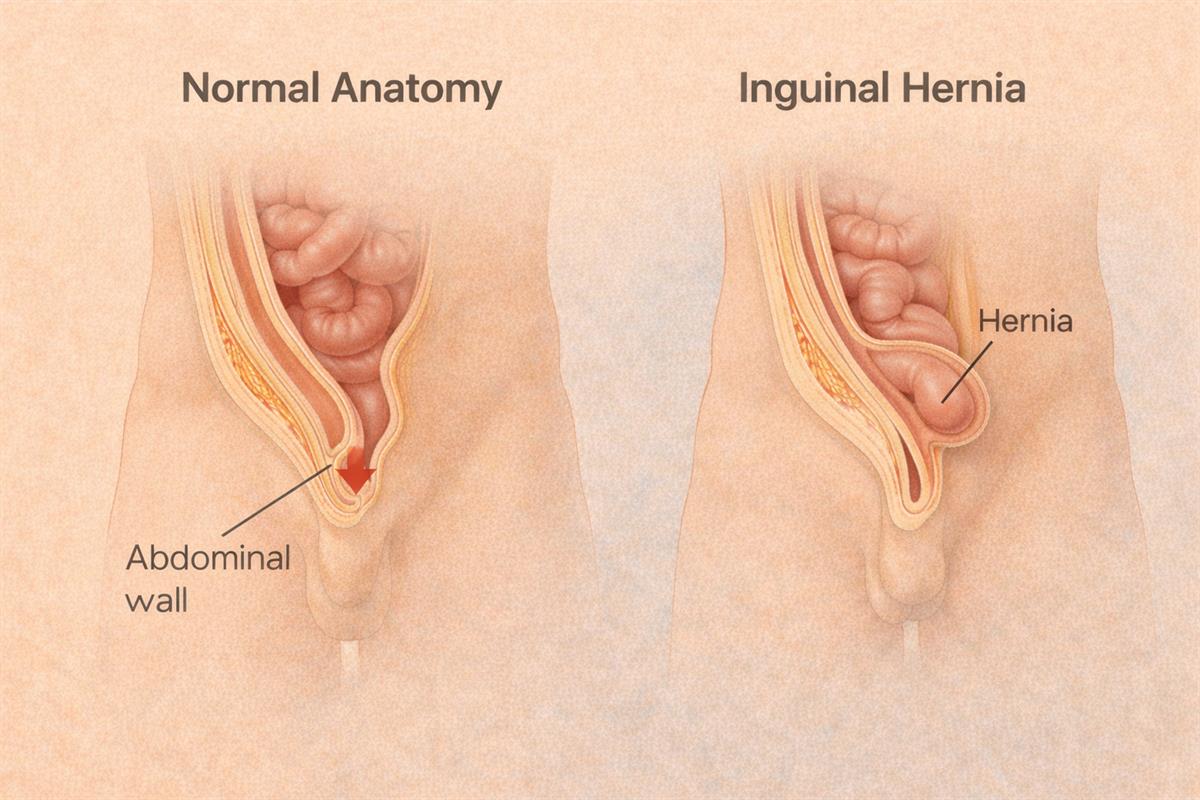
Inguinal Hernia
An inguinal hernia occurs when abdominal contents such as intestine or fat protrude through a weak area in the lower abdominal wall near the groin.It appears as a bulge in the groin that may increase with coughing, lifting, or straining.
What causes inguinal hernia?
- Weakness in the abdominal wall present from birth
- Increased pressure inside the abdomen
- Heavy lifting or strenuous activity
- Chronic cough or constipation
- Enlarged prostate causing straining during urination
- Obesity or sudden weight gain
- Previous abdominal surgery
- Age-related muscle weakness
What symptoms are associated with inguinal hernia?
- Visible or palpable groin swelling
- Discomfort or pain while standing or lifting
- Dragging or heavy sensation in the groin
- Pain that reduces on lying down
- Burning or aching sensation at the hernia site
- Severe pain if complications develop
When is medical help required?
Medical consultation is advised if a groin swelling is noticed, if pain increases, if the swelling becomes hard or irreducible, or if nausea, vomiting, or severe abdominal pain occurs.
What treatment options are available for inguinal hernia?
Non-surgical management
- Observation may be advised in selected asymptomatic patients
- Supportive measures do not cure the hernia
- Hernia belts provide temporary comfort only
- Definitive treatment is always surgical
Surgical treatment (definitive treatment)
Open Mesh Hernia Repair (Lichtenstein Repair)
- An incision is made over the groin
- Hernia contents are pushed back into the abdomen
- Mesh is placed to reinforce the weak area
Pros
- Suitable for large or complicated hernias
- Can be done under local or spinal anaesthesia
- Lower cost
- Effective with low recurrence
Cons
- Longer recovery compared to laparoscopic surgery
- More postoperative pain
- Larger scar
Laparoscopic Hernia Repair (TAPP / TEP)
- Small keyhole incisions are used
- Camera-guided repair from inside the abdomen
- Mesh placed behind the muscle layers
Pros
- Less postoperative pain
- Faster recovery and return to work
- Smaller scars
- Better for bilateral or recurrent hernias
Cons
- Requires general anaesthesia
- Higher cost
- Steeper learning curve
- Not ideal for all patients
Robotic Inguinal Hernia Repair
- Advanced form of laparoscopic surgery
- Robotic arms provide enhanced precision
Pros
- Excellent visualisation and accuracy
- Less pain and faster recovery
- Useful for complex or recurrent hernias
Cons
- Higher cost
- Limited availability
Why is surgery recommended for inguinal hernia?
- Hernias do not heal on their own
- Size and symptoms worsen over time
- Risk of life-threatening complications increases
- Surgery provides permanent repair
- Early surgery offers better outcomes and faster recovery
What dangers occur if inguinal hernia is left untreated?
- Progressive enlargement of the hernia
- Increasing pain and discomfort
- Incarceration where hernia cannot be pushed back
- Strangulation causing loss of blood supply to intestine
- Intestinal obstruction
- Bowel gangrene requiring emergency surgery
- Risk of sepsis and death if untreated
How is inguinal hernia surgery performed?
- The procedure involves repositioning herniated contents
- The weakened abdominal wall is reinforced
- A synthetic mesh is commonly used to prevent recurrence
- Surgery may be performed by open or laparoscopic methods
Choice depends on patient factors
What are the benefits of inguinal hernia surgery?
- Permanent cure of hernia
- Relief from pain and discomfort
- Prevention of complications
- Improved quality of life
- Early return to normal activities
What are the possible limitations and risks?
- Pain or swelling at surgical site
- Seroma or fluid collection
- Infection of wound or mesh
- Chronic groin pain in a small percentage
- Recurrence in rare cases
How does recovery and after care progress?
- Most patients are discharged the same day or next day
- Mild pain and swelling are common initially
- Normal walking is encouraged early
- Strenuous activity should be avoided for 4–6 weeks
- Return to desk work usually within 7–10 days