
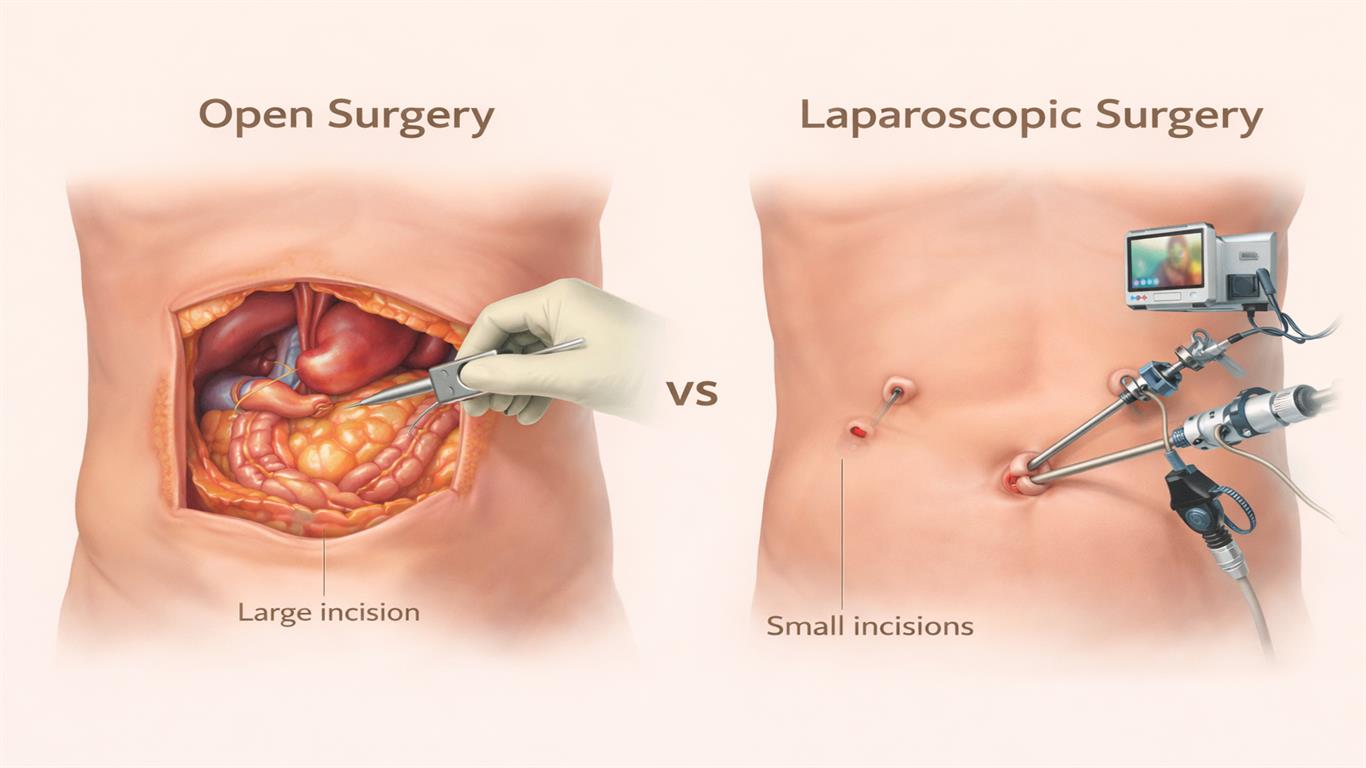
When surgery is advised, patients are often confused between open surgery and laparoscopic (keyhole) surgery. Both are effective, proven techniques. The best choice depends on the condition, patient factors, and surgical goals.
What Is Open Surgery?
Open surgery is the traditional method where a single, larger incision is made to directly access the affected area. The surgeon operates with a clear, direct view of the tissues. It has been safely performed for decades and is still widely used in many situations.
What Is Laparoscopic Surgery?
Laparoscopic surgery uses small cuts through which a camera and fine instruments are inserted. The surgeon operates by viewing magnified images on a screen. This technique is often called minimally invasive or keyhole surgery.
Key Differences Explained Simply
Incision Size and Scars
- Open surgery involves a larger cut, resulting in a visible scar.
- Laparoscopic surgery uses small incisions, leading to minimal scarring.
Pain After Surgery
- Postoperative pain is usually more with open surgery due to muscle cutting.
- Laparoscopic surgery generally causes less pain as muscle damage is minimal.
Recovery and Hospital Stay
- Open surgery may require a longer hospital stay and a longer recovery period.
- Laparoscopic surgery allows faster recovery and earlier return to daily activities.
Risk of Infection
- Larger wounds in open surgery slightly increase infection risk.
- Smaller incisions in laparoscopic surgery reduce this risk.
Surgical Precision
- Open surgery offers direct hand control and is useful in complex or emergency cases.
- Laparoscopic surgery provides magnified views, improving precision in planned surgeries.
Which One Is Better?
Neither approach is universally better. Each has a clear role.
Laparoscopic surgery is preferred when
- The condition is diagnosed early
- The surgery is planned and not an emergency
- Faster recovery is important
- Minimal scarring is desired
Open surgery is preferred when
- The condition is complicated or advanced
- There is infection, bowel damage, or emergency presentation
- Previous multiple surgeries make laparoscopy difficult
- Patient factors make laparoscopy unsafe
Final Takeaway
The success of surgery depends more on timely treatment and choosing the correct technique than on the size of the incision. The right approach is the one that offers maximum safety, effectiveness, and long-term benefit for the patient. A proper surgical evaluation helps decide which method is most suitable.